Battle Over Boilers
By Maria Fernanda Cestero Muñiz
Kaitlyn Quach believed talk about climate change was all “doom everywhere” and felt powerless. She attended the School of Visual Arts as part of her honors program. One of her courses required her to read Greta Thunberg’s The Climate Book and it changed her view completely.
She suddenly felt empowered.
“Even though I’m one person, I can still do something,” said Quach. “There should be no delay in climate change action. We can’t do anything else if we can’t live on the planet.”
Inspired by Thunberg’s book, Quach started volunteering at environmental rallies. In 2021, she joined the nonprofit environmental organization, Food and Water Watch. On November 30, Quach, along with other members of the organization rallied for New York City’s “most ambitious plan” for climate change: Local Law 97.
Local Law 97 was included in the Climate Mobilization Act passed by the City Council in 2019 under Mayor Bill de Blasio which aims to make New York City carbon neutral by 2050.
More than two-thirds of the city’s greenhouse gas emissions are produced from physical buildings. The goal is to reduce the emissions produced by the city’s buildings 40 percent by 2030 and 80 percent by 2050.
Under Local Law 97, buildings over 25 thousand square feet must reduce their emissions by their allotted amount starting in 2024 or face a fine of $268 per ton of emissions over their designated standard.
Despite the stated aim to reduce the city’s contributions of greenhouse gases, Eric Adams, the current mayor, proposed a “good faith” effort allowing buildings a two-year extension on the 2024 deadline if they show an effort to reduce their emissions. The Adams administration is currently developing the criteria for how those efforts will be assessed.
“It’s [Local Law 97] important to me because it’s already a law and it made me upset Eric [Mayor Eric Adams] is puppeteering to billionaires,” said Quach. “It’s up to us to do something.”
Together with her organization and community members, Quach stood in solidarity in front of one of the entrances to City Hall pleading for council members to support their cause.
“Really, we saw it as a betrayal of public interest, but also as a real setback for the climate movement in general,” said climate activist and Food and Water Watch organizer David Vassar. “The mayor, very disappointingly, and the real estate industry seem not to care so much about the public interest, the community interest and the climate that our kids are inheriting.”
Vassar was among several people arrested at the protest for obstructing traffic.
“We need to get the word out and show our commitment to the skies,” said Vassar. “And I would do it again.”
And he did. On Dec. 6, Vassar attended a rally hosted by his colleague, and Brooklyn-based senior organizer of Food and Water Watch, Eric Weltman.
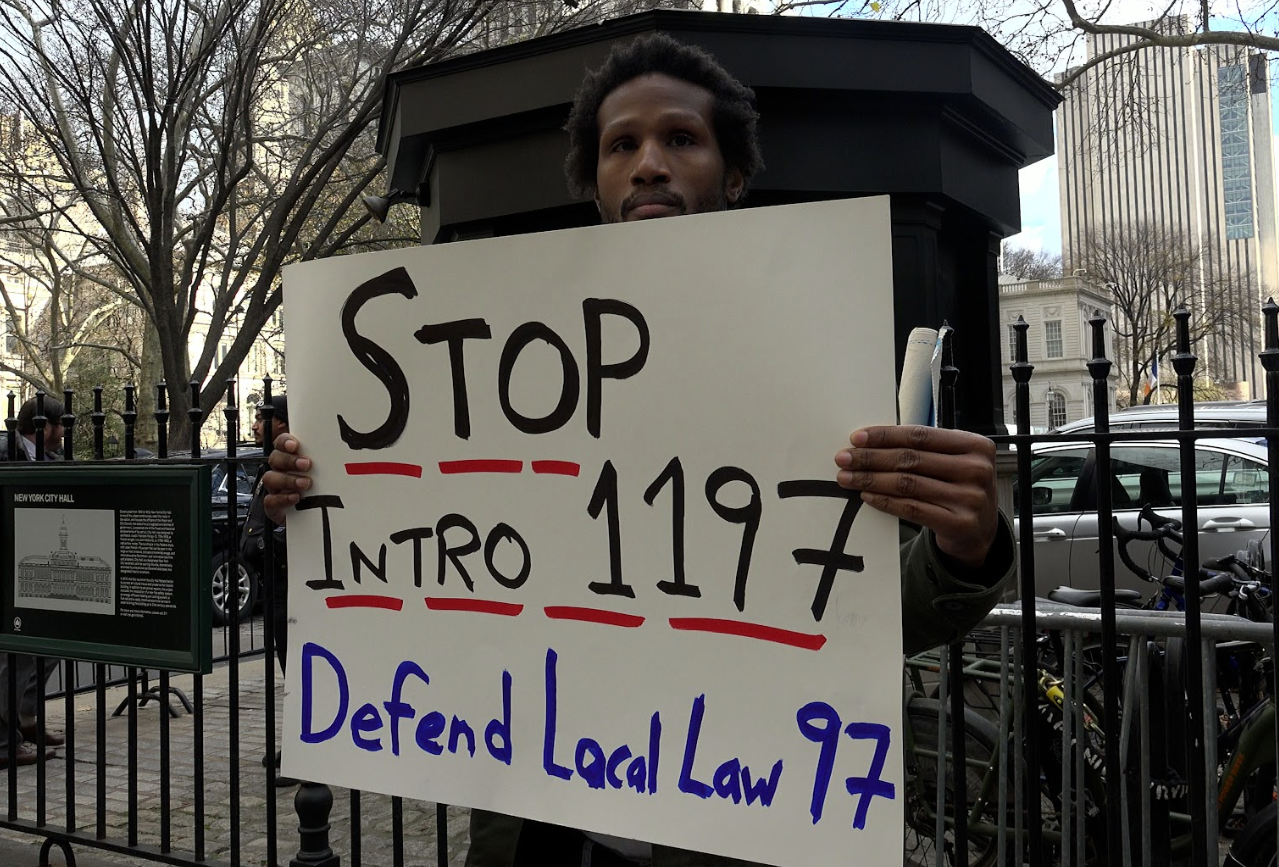
Rally attendee holds signs opposing 11-97.
City Hall was bustling with several protests, as Food and Water Watch, along with members of other organizations such as NYPIRG, stood by one of the entrances. Weltman encouraged members of the City Council to not support a newly introduced bill, 11-97.
The bill proposes to include green spaces while determining a building’s criteria for reducing emissions and will take into account if measures had been previously taken by buildings to reduce their emissions. It aims to weaken the criteria of Local Law 97 to accommodate co-ops and other complexes struggling to meet the target for cutting emissions.
Weltman has been involved in the nonprofit environmental organization for more than a dozen years. Fearing the consequences of climate change, Weltman is concerned about the planet his son will inherit.
“I have a son who’s very fearful about the future that portends for him and his peers as a consequence of climate change and I share his concerns for him and his generation,” he said. “Climate change is an existential threat to humanity.”
According to the city’s Department of Buildings, buildings in the five boroughs are complying with the emissions law at a higher rate than anticipated. Only 11 percent of buildings in the city have failed to comply with the regulations set for January 2024—half of which the city forecasted. Most of the buildings that are out of compliance are short between 10 and15 percent of their emission reduction goals. Many more buildings will be out of compliance for the 2030 reduction targets.
In order to meet the requirements, buildings will have to find the means to cut their emissions. Emission cuts can be linked to lighting, heating and cooling systems, and appliance usage. Other buildings will have to rewire their structures to comply or replace boilers, which can be costly.
“About 3,700 properties could be out of compliance and face over $200 million per year in penalties by next year,” according to a statement by the Real Estate of New York. “By 2030, over 13,500 properties could cumulatively face penalties as high as $900 million each year.”
Although many buildings comply with the “ambitious” goals for 2024, many buildings will be out of compliance by 2030. Some believe the efforts are too far-reaching.
The Linden Towers co-op #4 in Queens will be one of many apartment buildings that will fail to meet the 2030 goals. The three buildings which cumulatively hold 181 units are powered by two boilers running on natural gas which currently meet the criteria for the 2024 deadlines.
The current boilers were offered as an incentive by Con Edison. Con Ed had offered Linden Towers $96,000 if they remained on firm gas for four years, replacing their boilers that had run on dual fuel. Firm gas, or natural gas, is a relatively clean burning fossil fuel.
Con Edison stated they are incentivizing New Yorkers to reach the climate goals by building a “clean energy network”.
By 2030, the boilers will be out of compliance, causing more than $54,000 in fines in just one year, according to the Mayor’s Office of Climate and Environmental Justice. In addition to costly new electric boilers which may cost upwards of $100,000 each, the buildings will have to face rewiring in all units to be able to comply.
“Local Law 97 would affect us in the fact that we would have to buy new boilers that work on electricity only. That would be a tremendous cost to the co-ops,” said Arlene Fleishman, the president of the Linden Towers co-op board. “It would be a disaster. Where are we going to raise millions and millions of dollars if we took out new mortgages?”
A resident of the co-op for more than 60 years, Fleishman is concerned with the financial impact the law will have on her building and residents. Fleishman organized several meetings with the co-op board to discuss how the building is going to sustain incredible changes.
“If this [Local Law 97] forced us to put an electric boiler by a certain date, we would have to find the means,” said Fleishman. “The most affordable housing in this city is co-ops. I mean, we would no longer be affordable.”
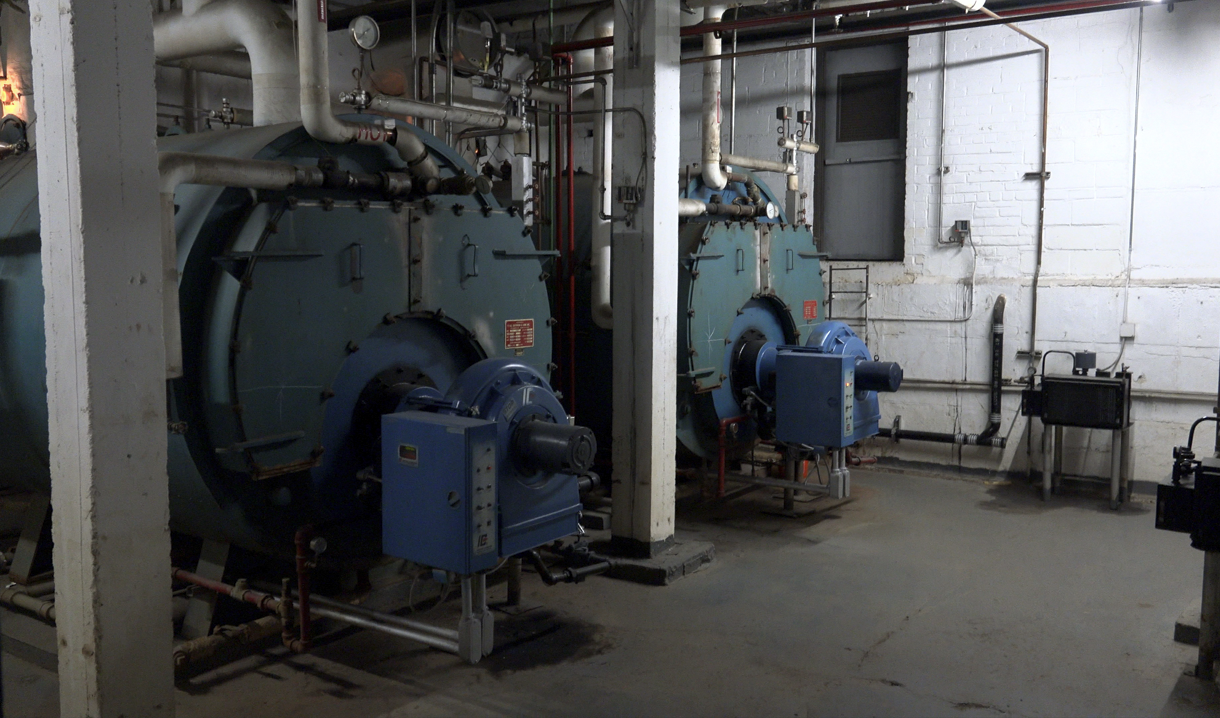
Linden Towers boilers which run on natural gas.
Although sympathetic to the cause, Fleishman is skeptical that the cost of a new boiler system and wiring will fall on all the residents, including herself . Showing letters she had printed for her residents in English and Chinese, Fleishman explained that she, along with others, do not know how they can come up with the funds necessary to meet the criteria.
Fleishman hopes council members will pass intro 11-97, which will help her building accommodate the criteria for Local Law 97 and help keep her building affordable for her residents.
“We’ve invested so many years to maintain the buildings and build an environment that we can all afford,” said Fleishman. “If we’re forced to make this, as written, it’s going to destroy all of us. Every co-op in this community will be destroyed.”
Along with other co-op presidents, Fleishman is encouraging their local city councilwoman to reflect on the financial impact the Local Law will have on affordable housing units across the city.
“A two-year extension will do nothing,” said Fleishman. “I know some city council members support what’s going on- we all do. We all want to reduce carbon emissions. We all want to live in a safe environment … but it can’t be done like this.”