Working Waterfront
New York has a rich history of industrial ports. The Blue highway takes advantage of the city's natural resource: water. But the working waterfront in Red Hook may be cut in half.
The Last Waterfront
The shadows of trucks are cast across the red-brick industrial warehouses. Harsh wind whips against docked boats, forcing them to gently but repeatedly hit the wooden pier, rocking above the waves.
There is whistling and swooshing. Otherwise, the Red Hook harbor is quiet.
It’s 2 a.m., and Capt. Rich Narusecwicz is preparing his oil tanker, a small, specialized ship that delivers fuel to other vessels. Steering from the Buttermilk Channel, past the Brooklyn Marine Terminal and into Manhattan, Narusecwicz’s ship is one of the few on the water. “When I started in this harbor… there’d be 25 ships at this anchorage. Twenty-five. Now, there might be four or five.”
He points to development projects and remembers what used to be there. “You see there, where the Amazon warehouse is, years ago it was a sugar refining plant… And you see that crane, that used to be Todd Shipyard, then New York Shipyard… Now it’s a put-together-yourself furniture Ikea.”
Narusecwicz has worked on these waters for almost 46 years. “An old-school maritime community,” that’s how he remembers Red Hook. It had shipyards and industrial machinery. Public housing, known as the Red Hook Houses, was built for dockworkers. The waterways were full of life: cocoa beans from the Ivory Coast, fresh produce from South America.
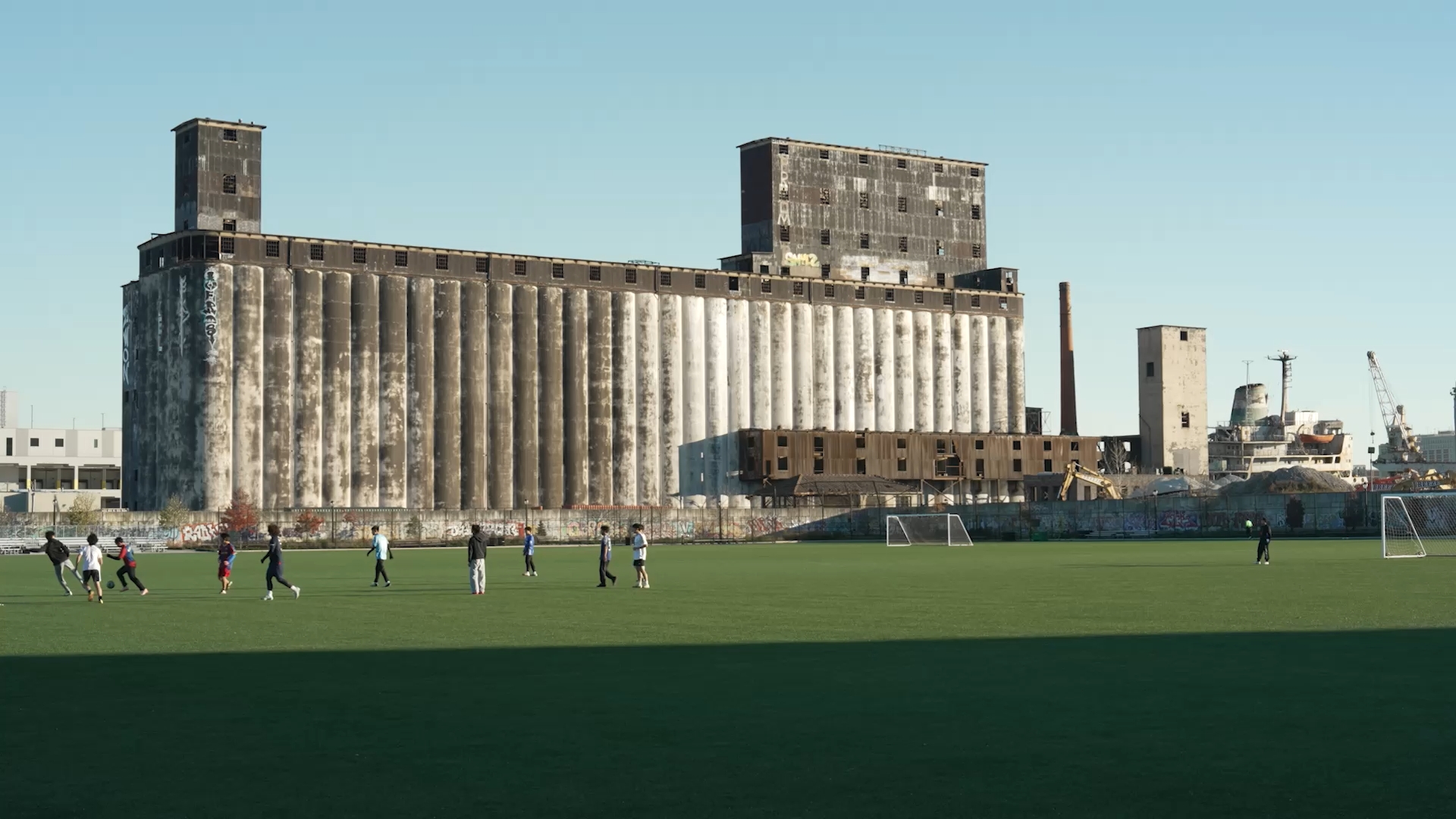
Today, as Red Hook remains one of New York City’s last working waterfronts, the area faces pressure from a newly approved plan that could reshape the port. Its 122 acres of manufacturing land, known as the Brooklyn Marine Terminal, are at the center of an approved $3.5 billion redevelopment plan that would cut the industrial waterfront in half. It will be replaced with luxury high-rises, thousands of housing units, and a redesigned mixed-use district. Supporters say the plan will modernize the port, electrify aging diesel operations, and bring funding to deteriorating public housing.
But many residents and maritime advocates fear it will erode the working waterfront, overwhelm a transit-starved neighborhood, and transform Red Hook’s character.
Historically, this port was New York City’s largest after the Civil War. “With the growth of trade, merchants and ship owners needed a place to grow into. And Red Hook, particularly around the Atlantic Basin, was one of the earliest places where that growth took place,” said Andrew Genn, the former senior vice president of the NYC Economic Development Corporation. “It’s in the upper bay, which is a very strategic location because it’s close to transportation and close to population.”
But this all dramatically changed with containerization.
Before the 1950s, most ships were handled by stevedores taking individual break-bulk packages and moving them from ship to shore and shore to ship. “Containerization was the invention of a shipping container where all of the stuff could be put into a metal box and then moved more efficiently by cranes on and off of a ship,” explains Genn. The shift revolutionized shipping by significantly reducing costs. It changed the profile of ports, making certain piers obsolete while large open land areas became essential for giant cranes. Port operations moved out of the city.
However, despite these technological changes and changing infrastructure, Red Hook’s port is crucial for New York City.
Deborah Gans, a professor of architecture at Pratt Institute, explains that unlike classic 19th century industrial ports, this one functions as a transportation and storage facility. “It’s about moving goods,” she says.
Genn notes that tugboats and barges here move things New Yorkers don’t want on the roads: garbage and recyclables. At the same time, the Department of Sanitation uses marine transfer stations to move solid waste out of the city, “invisibly to New York City residents.”
Having lived through these changes, Narusecwicz shakes his head and laughs sarcastically when asked about the BMT project.
“It’s economics. Can we still do this and turn a profit? If not, what are we going to do with it? They want to keep the industry here,” he says. “But it’s always something with development. Development of condos, townhouses, if you look up here. In the Atlantic Basin, they used to be a cold storage place where everything was…coming in from overseas. It’s condos now.”
In May 2024, the Port Authority transferred operational control of the Red Hook waterfront — including the container terminal — to the EDC. The move marked a transition phase; the EDC hoped to redevelop the waterfront into a mixed-use district. After a long political battle and community backlash, on Sept. 22 the committee voted to approve the project. The announcement called it “a vision to transform a key site on the Brooklyn waterfront into a modern maritime port and vibrant mixed-use community.”
For more than a year, the project symbolized a larger struggle: what is the importance of a working waterfront — and who gets to decide its future?
Mike Stamatis, president of the Red Hook Container Terminal — who negotiated with the EDC and voted to support the project — says the plan will save the port. Having led the port for 15 years, he recalls that even when he got the job, the Port Authority planned to sell and monetize the land. “I was told by the Port Authority, it was going to be a very short-term job because they were still planning to close it.”
For Stamatis, this negotiation was a matter of survival. The port will get renovations with some new infrastructure. That for him is a win.
“It’s the city’s utility closet,” he exclaims. “Thirty-thousand trucks total are eliminated annually from the bridges and local streets.” Stamatis also argues that the port provides crucial services during emergencies, pointing to Hurricane Sandy as proof of how essential it is to have a port that can bring in food, commodities, fuel, and other essentials when the city needs them most.
And while Carolina Salguero, founder of PortSide NewYork, agrees on the port’s importance, she believes the working waterfront is a public good and should receive more investment, not less. “If this vision plan is executed, I think that apart from the barge port over there, a massive gentrification will ensue,” she says.
Salguero notes that the area includes vessels moving fuel, sand and stone, a container port, a cruise terminal, shipyard companies, two museums, a commercial berth, harbor tours, and the New York Ferry.
Other than the port, the future of the rest of the working waterfront is unclear.
Gans is frustrated by the narrow choices in these development conversations; she believes the city and developers need more creativity in answering questions of housing, port use, and public space. “It’s a failure of imagination.”
This kind of planning, she says, creates further problems for the crisis ahead.
Salguero agrees. In her view, we should have a waterfront that is “not a glitzy new place for newcomers” but rather works to serve the city.
“I am concerned because the smaller it gets, the harder it is for it to be a modern marine terminal… Size does matter,” Genn says. If Red Hook loses too much ground, goods like structural lumber will be forced onto trucks and highways instead. “It’s just going to be trucked in from New Jersey.”
As debate continues on immediate plans to the broader future of the waterfront and surrounding community, the tension between industrial needs and real-estate pressure is clear.
“It’s cursed by the view,” Stamatis says with a half-laugh. “I would have gotten a 90-year lease from the Port Authority and the port would be secure if it wasn’t for this view.”