Restoring Habitats
A look at how the city’s coastal communities confront restoration challenges, navigate the impacts of buyout programs, lead cleanup efforts, and push back against a controversial new pipeline.
Pipeline Politics
In the Rockaways, a Battle Over the Future of Energy
A turf war is unfolding in the Rockaways, where the Atlantic meets a neighborhood that’s spent years fighting over what should or should not run beneath the waters. For activists, environmental groups, and locals, the Williams NESE pipeline has become more than infrastructure; it’s a line in the sand.
After years of denials and fierce pushback, New York State has tipped the scales, granting the pipeline a pivotal water certification.
The NESE project, developed by Williams Companies, is a planned expansion of the existing Transco natural gas pipeline to bring additional gas into New York City. The original plan calls for 23.5 miles of new underwater pipeline. Over 17 of those miles would run along Raritan Bay and the Lower New York Bay before the line would surface near the Rockaway Peninsula. The pipeline would connect to the existing Rockaway Delivery Lateral and would be 26 inches in diameter. The project claims that the line will deliver 400,000 dekatherms of gas per day to Brooklyn, Queens, and Long Island.
This plan was introduced in 2017. Following the proposal, environmental groups such as the Sierra Club and 350 Brooklyn raised concerns about ocean impact, climate goals, and water quality. Sara Gronim, a main organizer of 350Brooklyn’s resistance in 2017 and current co-leader, remembers the birth of NESE and how there was an immediate call to action.
“When this project first came to our attention in 2017, it was an obvious target, because it represents that it would cause such a massive increase in frack gas delivery from the Pennsylvania fracking fields, and lock us into decades of obligation to pay for this, and was absolutely the wrong direction for New York State,” Gronim said.
At its core, the NESE pipeline conflict is about who has the power and influence to shape the future of New York’s shorelines. Williams is promising reliability through a dependable supply of natural gas. Environmental groups are warning of the long-term damage to the ocean, climate, and quality of life that they believe the pipeline will cause. With lawsuits underway and government agencies reversing earlier denials, the outcome of this fight will determine what takes precedent: New York’s environment or its energy future.
Fast forward to 2025. The NESE line will first be built by constructing onshore and offshore pipeline segments in New York, New Jersey, and Pennsylvania, as well as a new compression station in Jersey. Jet trenching, clamshell dredging, and horizontal directional drilling to bury the pipeline at least four feet below the seabed are the methods required for the offshore construction.
In 2019, the Federal Energy Regulatory Commission approved the project, but the New York State Department of Environmental Conservation and New Jersey Department of Environmental Protection denied key water permits, citing Clean Water Act concerns. In the years following, Williams revised and resubmitted its plan multiple times, having New Jersey and New York deny new bids, resulting in Williams cancelling its plan in May 2024, signaling to what many believed was the end of years of fighting.
“We really started to be on a roll in terms of getting the New York City level, other local levels, and at the state level, significant movement towards the state being a model of climate action,” Gronim said. “We thought that was all… You know, history.”
But under new political conditions, in May 2025, Williams filed new applications in NY, NJ, and PA for environmental and water permits and petitioned the FERC to reinstate the federal certificate of approval.
This decision reignited opposition from local activists. Groups reformed and began to mobilize against Williams once again. Alex Pavlov has been a Rockaway resident his entire life. He grew up fishing, surfing, and enjoying the beaches with friends and family. It was his memories of the bay that called him to join the opposition.
“I am not an activist. I mean…I guess I am now, but I have never been a part of a resistance before this… I would attend gatherings and put flyers up around town,” Pavlov said. “I feel like that shows how bad this pipeline is because I am usually pretty checked out of politics and social events.”
Against the backdrop of climate activist pushback, Williams claims that the line will improve energy affordability and reliability in New York City by expanding access to natural gas and mitigating regional emissions by supporting cleaner energy.
The project aims to improve energy reliability, support regional emissions reductions, and prevent supply shortages in the winter season. Williams has also promised to be environmentally conscious by using horizontal directional drilling and clamshell dredging to bury the pipeline at least four feet below the seabed. Williams argues that the pipeline is needed to expand the existing Transco system to provide natural gas to Brooklyn, New York City, Queens, and Long Island.
But the Natural Resources Defense Council argues otherwise. Citing National Grid’s Long Term Gas System Plans, proceedings indicated that National Grid’s gas demand, as outlined, did not need the additional gas supply within a 20-year planning period.
According to the New York State Public Service Commission, there is no shortage of natural gas within the region. A 20-year forecast illustrates an excessive supply by an estimated 195,000 dekatherms per day in 2025-2026 and a peaking surplus in 2029-2030 that would extend through 2050.
Because there is seemingly no demand for extra gas, some climate activists are speculating that the line’s approval was a political move, rather than a sound policy decision based on energy affordability and a need for capacity.
In April, as part of an executive order declaring an energy emergency in the United States, President Donald Trump cancelled Empire Wind, an offshore wind farm located 15-30 miles off the coast of Long Island, New York, that generates renewable energy.
“I know two union workers who were out of work after the stop-work order. Just like that,” Pavlov said. “They did not know what was going to happen. Kinda played a waiting game until the government could get it all sorted”.
By May, Trump lifted his stop-work order. The White House made a statement claiming Governor Hochul had “caved” and agreed to permit “two natural gas pipelines to advance” through New York.
In response, Hochul says no deal was made, and she will follow federal and state requirements when approving the pipeline, and that the stop work order was lifted by simply explaining why the Empire Wind Project is important.
“Who knows where the truth lies. None of us in the room but Williams reapplied to FERC in May,” Gronim said.
This opened the door for Williams. Plans and proposals moved quickly, and DEC issued the crucial water quality certifications. After that, the fight was seemingly over. That was until a coalition of environmental groups filed suit against the New York State Department of Environmental Conservation for approving the water quality certification for the NESE pipeline.
Earthjustice, a nonprofit public interest environmental law organization, is representing NY/NJ Baykeeper, Food & Water Watch, Surfrider, Protectors of Pine Oak Woods, and Sierra Club in the case, with in-house attorneys representing NRDC.
The DEC had previously denied the water certification three separate times due to raised concerns regarding construction and how the process would dredge toxic seafloor sediments in New York Harbor and cause immense damage to the ecosystem. This violated New York’s water quality standards and risks harming residents and marine life.
Despite the three prior denials, the DEC ultimately approved the certificate, stating that the United States Environmental Protection Agency had updated its framework and, as a result, water quality reviews had changed. The DEC also cited revised ecological data.
The DEC stated that this approval is contingent on the DEC itself overseeing construction, as well as the developers integrating third-party monitors to oversee construction and implementing a plan to minimize contaminants in Raritan Bay and Lower New York Bay. The DEC is also requiring Williams to fund and conduct $23.5 million worth of environmental protection and restoration work to mitigate any damage the pipeline might cause.
Despite these conditions, environmental groups argue that the damage the NESE pipeline would cause is irreparable to the climate. Jared Knicley, managing litigator at the Natural Resources Defense Council, argues the New York State DEC violated the Clean Water Act by granting William’s water certification.
“It’s not just our position; it’s New York state’s position, at least until recently,” Knicley said. “Twice, the NYSDEC has denied a permit for NESE for failure to show compliance with the state’s water quality standards. Nothing has changed since that approval. It’s the same project. The result should have been the same, too.”
The core claims in the lawsuit are that NYSDEC’s approval violates Section 401 of the Clean Water Act and New York’s own water quality standards, environmental destruction from tearing up the harbor floor, and dredging up harmful sediment to the marine life and harm to vulnerable fishing areas that are home to sensitive shellfish beds.
Regarding the DEC granting the water quality certification, NRDC is unable to directly pinpoint what prompted the change of heart.
“We can’t speculate on what motivated NYSDEC to flip-flop from its earlier, robust findings that the pipeline could not be built without violating state water standards. What we do know is that the reasons NYSDEC has given don’t add up,” Knicley said.
If NRDC is successful and wins the suit, it will ask the courts to vacate the water quality certification.
“Transco may reapply for a new certification, but NYSDEC’s flawed approval would no longer be in place,” Knicley said.
With legal action playing out, the core of the fight is the environmental risks that opponents say the state overlooked. Greg Remaud, the Executive Director of NY/NJ Baykeeper, studies the dangers the pipeline poses to marine life and has raised an alarm about contaminated sediments.
“NY/NJ Baykeeper believes that the testing conducted for the pipeline was very limited and did not go deep enough or cover a large enough area,” Remaud said. “Many of the contaminants in Raritan Bay have been there for long periods of time and have been covered by sandy sediment over time, and lie at depths below what was tested.”
Like many, Remaud believes the DEC approval was a political move that did not necessarily consider the environmental ramifications.
“It (NESE pipeline) symbolizes the harmful back-pedaling on addressing climate change and sea level rise that threatens to drown our wetlands and damage homes and property,” he said. “It is important to remember that this is not an essential source of energy or essential infrastructure; it is for one company that has the right connections, so it also symbolizes corporate greed and bad politics.”
As the legal battle plays out, the future of the NESE Pipeline remains uncertain. As state regulators and Williams argue that preventive measures and intense oversight can mitigate environmental damage, environmental activists contend that the threats to water quality, marine life, and the climate are too vital to ignore.
The court’s ruling will not only decide the pipeline’s fate, but it will also set a precedent for how New York State can moderate the debate between energy development and environmental protection.
“People just want to be able to swim or fish in the water in their neighborhood. I get the energy demand, but why does it seem like one has to screw the other?” Pavlov said.
From Guns to Green
The Remarkable Story of Governors Island
It’s a brisk Friday morning towards the end of November. Cold winds sweep through the open arches of the Battery Maritime Building as people make their way toward the 8 a.m. ferry to Governors Island.
Sandwiched between Manhattan’s skyscrapers and the Brooklyn waterfront, this 172-acre island—accessible solely by ferry—draws close to a million visitors each year. It has become a place of learning and an incubator for innovative responses to the city’s climate challenges.
The morning ferry is filled with schoolchildren—ponytails swinging, Dunkin’ Donuts drinks in hand, Snapple bottles tucked under their arms- as they exchange all kinds of gossip. They are on the way to Harbor School, one of the city’s most important centers of maritime and environmental learning. Since its establishment on the island in 2010, the Harbor School has been pivotal in Governors Island’s climate movement. It’s hard to imagine that only a few decades earlier, people crossing this river wore different badges and uniforms and carried guns instead of school bags.
From being a Dutch and British colony to serving as several army bases, for the United States Army, “Governors Island has a rich history,” says Sarah Krautheim, chief of staff at the Trust for Governors Island.
In the 1660s, the fort served as a British colonial outpost reserved exclusively for the royal governors of New York—giving it its now-familiar name, “Governors Island.”
Over the years, the nut trees that once covered this island watched bullets fly around them. Two massive forts were built to defend New York Harbor from foreign naval threats. After America’s independence, the island became the headquarters of the U.S. Army’s First Army base and later the largest Coast Guard base in the world, housing nearly 3,000 residents.
Many buildings that once functioned as armories and field hospitals got converted to government offices, staff quarters, and, eventually, the Harbor School. The bronze propeller that once defended the island now rests on wooden planks as a reminder of the bloodied past.
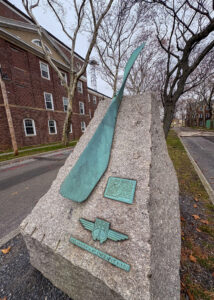
The bronze propeller now stands as a monument honoring Governors Island’s rich history.
After the Coast Guard departed in the 1990s, the federal government sold most of the island to New York in 2003 for $1, under the condition that it be used for the public good—specifically, arts, culture, education, and environmental innovation.
Today, the Trust for Governors Island – a nonprofit organization established by the City of New York – serves as the island’s custodian, responsible for planning, operations, and ongoing development. Its mission is to support year-round public access and build long-term financial sustainability.
“There isn’t any climate innovation district that exists now—and this island is perfect for that,” says Krautheim.
The ice cream cone-shaped island is divided into development zones and includes a 42-acre park with a view of the vast Manhattan skyscrapers and the Statue of Liberty. The island harbors a growing network of educational spaces, nonprofits, and startups, each dedicated to testing solutions for the city’s most urgent environmental challenges. Many of the students, researchers, and volunteers working at these places take the same 8 a.m. ferry from Manhattan.
Andrea Lieske has been taking the morning ferry to Governors Island for more than a decade and has watched the island change “exponentially” since it was first opened to the public. Lieske works with Earth Matter, an organization focused on waste management in New York.
In 2017, Earth Matter and the Trust launched Zero Waste Island, an initiative aimed at reducing the island’s waste export to zero. Through a “hands-on approach” and a year-long internship program, Lieske and volunteers process an average of 600 tons of organic waste annually—125 tons of which is generated on Governors Island itself, including food scraps, compostable utensils, and landscaping debris. Compost created from city waste is used to grow a food forest and a lavender garden on the island. They also run summer workshops to teach the public about waste segregation, composting, and keeping the city clean. Lieske believes everything they do “has an educational purpose” in mind.
Through partnerships with environmental groups, students from across New York City engage in hands-on marine science, harbor restoration, aquaculture, and sustainability projects on the island. This helps connect them to the living ecosystem of New York Harbor.
On the shores of Governors Island, 36 children shout “oysters!” as they pose for a picture in hazmat suits. According to their teacher, Lia Friedman, these students “will spend their day clearing trash from shell piers to build new habitats for oysters as part of their annual day of service.”
This is part of a collaboration between the M.S. 243 Center School and the Billion Oyster Project—an initiative aimed at restoring one billion oysters in New York’s waterways by 2035.
Coordinator Mallory Easton believes “restoration and education go hand in hand.” Launched from the Harbor School in 2017, the Billion Oyster Project is a national model for community-based climate innovation. Easton sees Governors Island as “a much more natural and spacious part of New York that can reimagine what a city can be.”
In spring and summer, the island comes alive: many abandoned buildings become incubators for new ideas, and the once-abandoned military chapel, formerly known as Our Lady Star of the Sea, transforms into a venue for the island’s Climate Week and other events. It’s part of a Trust-led initiative to support innovations focused on water—cleaning it, conserving it, using it as a resource. Six initiatives recently received $10,000 grants and access to a shared $100,000 pool to pilot their projects, along with space on the island to install necessary equipment.
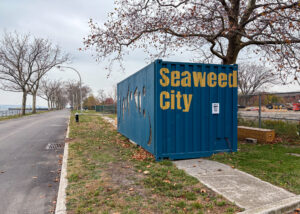
Seaweed City is one of the initiatives to receive a $10,000 grant, as well as space on the island to develop the project.
Winters are usually quiet on Governors Island. Only an Ethiopian restaurant stays open through the season; the rest close down. According to Jonathan Edalgo, the restaurant manager, summertime is when the island truly “opens to the public,” drawing “up to 10,000 visitors per day.”
But on another cozy corner of the island, two pairs of binoculars are making the most of the weather and the quiet. Birders Mariam Rakowsky and Alan Drogin are part of the Linnean Society for Birders and have been visiting the Island since it opened up to the public in 2005; today, they are chasing winter migratory birds. Rakowsky was excited to spot an owl. They are happy to “see the Island opening up for people to walk around and explore.”
But things might be changing. As they search for chipping sparrows, their binoculars increasingly catch construction cranes and scaffolding from the nearby development zones.
In 2023, the trust announced a $700 million investment to turn the island’s last major undeveloped area into a 400,000-square-foot campus known as the New York Climate Exchange—part of its push to make the island a leading hub for green education. Sarah Krautheim is enthusiastic about the venture.
The initial idea of a climate center was announced in 2020, with over a decade of planning. “At the time, New York City was grappling with the COVID-19 Pandemic, and it was time to take a long view,” says Krautheim. The NY Climate Exchange is a first-of-its-kind consortium led by Stony Brook University and is expected to open in 2028.
The climate hub will serve as a “living laboratory” featuring resilient design, with renderings showing shiny, sloped buildings covered in vegetation. It will include two newly constructed classrooms and research buildings on three acres of currently undeveloped land, and will also utilize some historic buildings on the island.
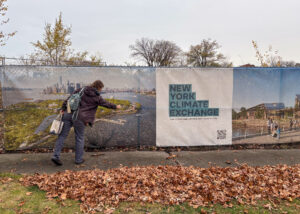
Andrea Lieske on the site of the New York Climate Exchange
Volunteers like Andrea Lieske are hopeful about the new changes. She believes “it’s a great idea” and would do well. Their farm is set to be displaced in the coming summer as part of a restructuring effort, and Charlie Bayrer, the co-founder of Earth Matters, suggested that as the island undertakes this ambitious project, it’s best to “accommodate the changes.”
Rakowsky is not that happy that the Island would get “potentially commercialized,” but believes the new developments are for the best, even if it means some inconveniences. “As long as they don’t put a hotel in this place, I am fine,” she exclaims.
But some people don’t share the same optimism.
The Metro Area Governors Island Coalition (M.A.G.I.C) has filed lawsuits challenging the 2021 rezoning and the potential construction of the buildings, arguing that large-scale development threatens the island’s serenity and historic architecture.
Roger Manning, co-founder of M.A.G.I.C., argued at a 2024 press conference that the city’s plan is nearly three times larger than the public’s original understanding of what it would be, “and the drastic increase in scale of development is unacceptable.”
M.A.G.I.C.’s concerns do not revolve around the importance of the climate change center, but around the buildings it would occupy. “The center only occupies 25% of the space; the rest of the land will be exploited by the developers, which is a violation of the original 2003 deed,” says Manning.
According to Manning, their movement met with Stony Brook University to raise concerns regarding the buildings, and they took many of the suggestions into consideration. Still, the issue of rezoning remains, which he claims is “purely greenwashed.” They argue that the trust should prioritize reimagining already existing vacant buildings on the island and should stop constructing new ones.
Governors Island has emerged as a hub for climate innovation over the last decade. As the Trust advances plans for the new climate center, Krautheim says the goal is to answer a central question: “Can New York lead in climate solutions and prepare New Yorkers for green jobs?”
Whether they can do that while preserving the island’s identity as a conservation haven is the great challenge ahead.